Design Thinking

Design Thinking

Great article concerning design thinking, and how business should embrace design thinking and methodology. The reasoning is an ever changing social-media connected consumer base. Gone are the days of ‘managing’ a product or service and shaping consumers perception via various techniques such as advertising, brand management, hype and hyperbole (well maybe not quite gone – but their effect is certainly diminished). Consumers feel empowered, they feel in control and to a certain extent they are.

Where designers come into all this is that designers design experiences and are best placed in this new media/web 2.0 world to communicate a concept, idea, message, meme in an honest way. Consumers/Users also want to design their own experiences so they require designers to supply the tools via good interaction design or to supply the skills to visualise those experiences. Further, as mentioned in the article, design goes much further than mere aesthetics (which is still a popular perception of design). Design can be the design of systems, architectures, information work flows, processes, platforms, concepts, ideas, interaction and possibly even political discourse.

That’s Design As Margaret Mead, Design As Anthropology. Design is so popular today mostly because business sees design as connecting it to the consumer populace in a deep, fundamental and honest way. An honest way. If you are in the myth-making business, you don’t need design. You need a great ad agency.

Design should not give up its special ability to visualize ideas and give form to options. Design should extend its brief to embrace a more abstract and formalized expression of how it translates empathy to creativity and then to form and experience. Be broad, not narrow. Global, not parochial. Do not deny the powerful problem-solving abilities of design to the cultures of business and society.

From: CEOs Must Be Designers, Not Just Hire Them. Think Steve Jobs And iPhone | Link

And one of the bits I really like, Britain is doing rather well in this area.

A report by the Work Foundation, which looked at 13 sectors within the entertainment and design industries, found that cultural exports from Britain, such as music and television programmes, are greater than from any other country. According to the findings, Britain’s creative sector employs 1.8 million people and makes up 7.3 per cent of the national economy.

From: Creative industries ‘fuel Britain’s economic growth’ | Link
All night Disco party

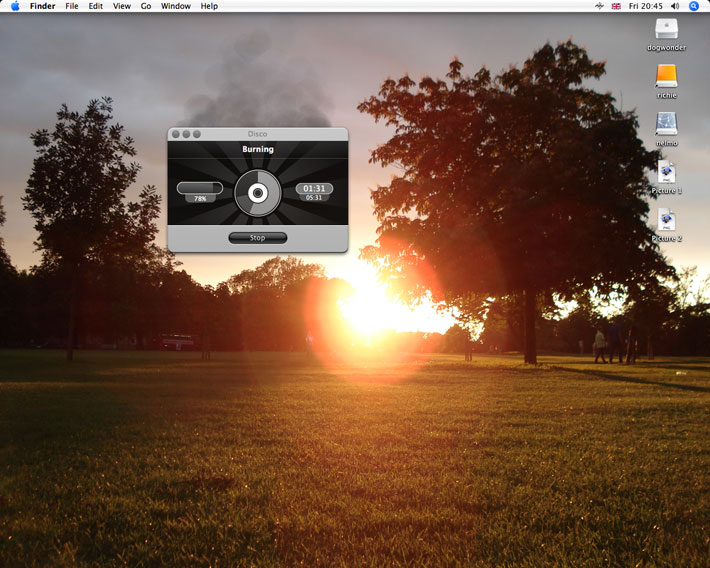
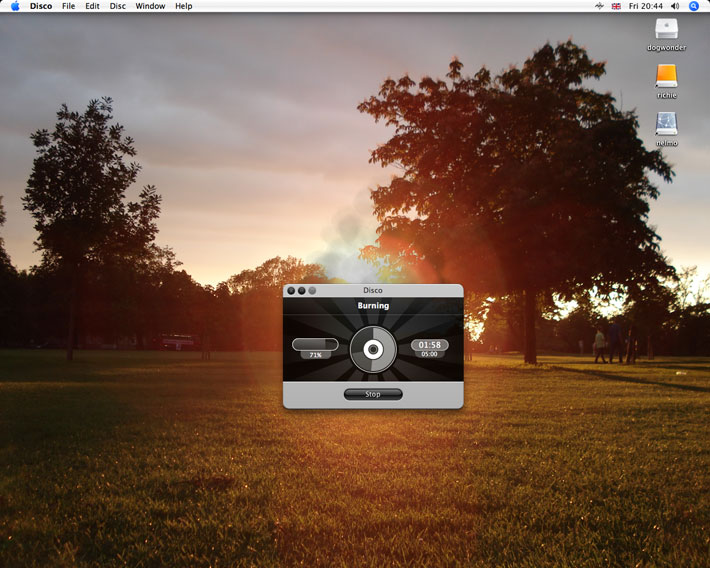
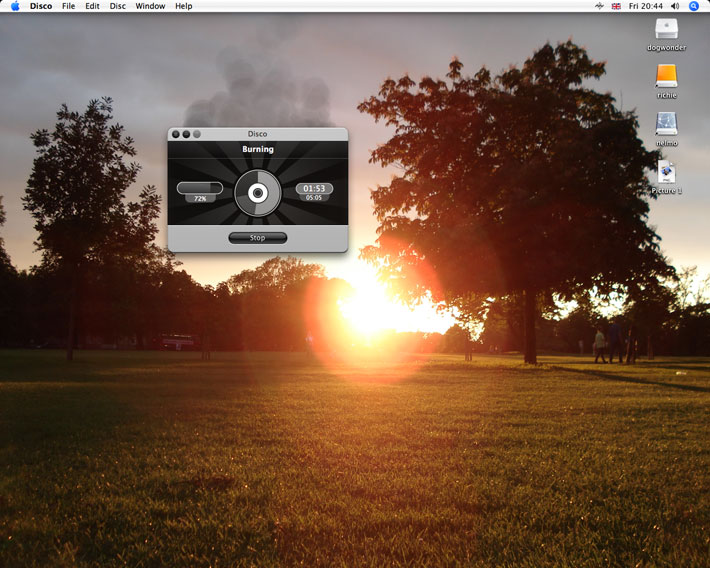
Loving the application Disco. The app is very god, making burning very easy , yet for me it’s the ‘smoke’ feature. When the application is burning a disc virtual smoke emits from the top of the app. I felt rewarded for burning a disk by the simple mechanism of displaying a virtual representation of the process.

It seems there may be more instances of this given the rumour that Apple are going to announce similar features in Leopard.

Core Animation will allow programmers to give their applications flashy, animated interfaces. Some developers think Core Animation is so important, it will usher in the biggest changes to computer interfaces since the original Mac shipped three decades ago.

From: Wired – Kiss Boring Interfaces Goodbye With Apple’s New Animated OS

I for one am somewhat excited at the concept of pliant, responsive applications. I think that with features such as this I can see a lot of web based apps migrating back to the desktop.

Here are some screengrabs I cooked up.

Disco - Smoke
Disco - Smoke
Disco - Smoke

Josef Muller-Brockmann

I love the work of the Swiss designer Josef Müller-Brockmann, his ability to create visually appealing designs from simple techniques is stunning. This style is (I hope) something I try to achieve in my design approach, described as ‘objective, radically minimalist geometric design’ Müller-Brockmann was a ‘leading practitioner and theorist of the Swiss Style, which sought a universal graphic expression through a grid-based design purged of extraneous illustration and subjective feeling.’

Although I also love over-elaborate designs, my heart will always veer towards the simple and minimalist (in my likes and design style), not because I don’t like decoration, there is plenty of space for decorative designs, but I just feel that when attempting to communicate a message that the message is the most important part of the design that should be enhanced not overawed by the visual stimulus around it.

From the man himself:

In my work, however, I have always aspired to a distinct arrangement of typographic and pictorial elements, the clear identification of priorities. The formal organisation of the surface by means of the grid, a knowledge of the rules that govern legibility (line length, word and letter spacing and so on) and the meaningful use of colour are among the tools a designer must master in order to complete his or her task in a rational and economic manner.

What I try to achieve in my work is to communicate information about an idea, event or product as clearly as possible. Such a down-to-earth presentation is barely affected by present-day trends. But it is not so much a question of making a statement that will be valid for all time as of being able to communicate information to the recipient in a way that leaves him or her free to form a positive or negative opinion . . .

JMB

2026 2025 2024 2023 2022 2021 2020 2019 2017 2016 2014 2013 2012 2011 2010 2009 2008 2007 2006 2005 2004